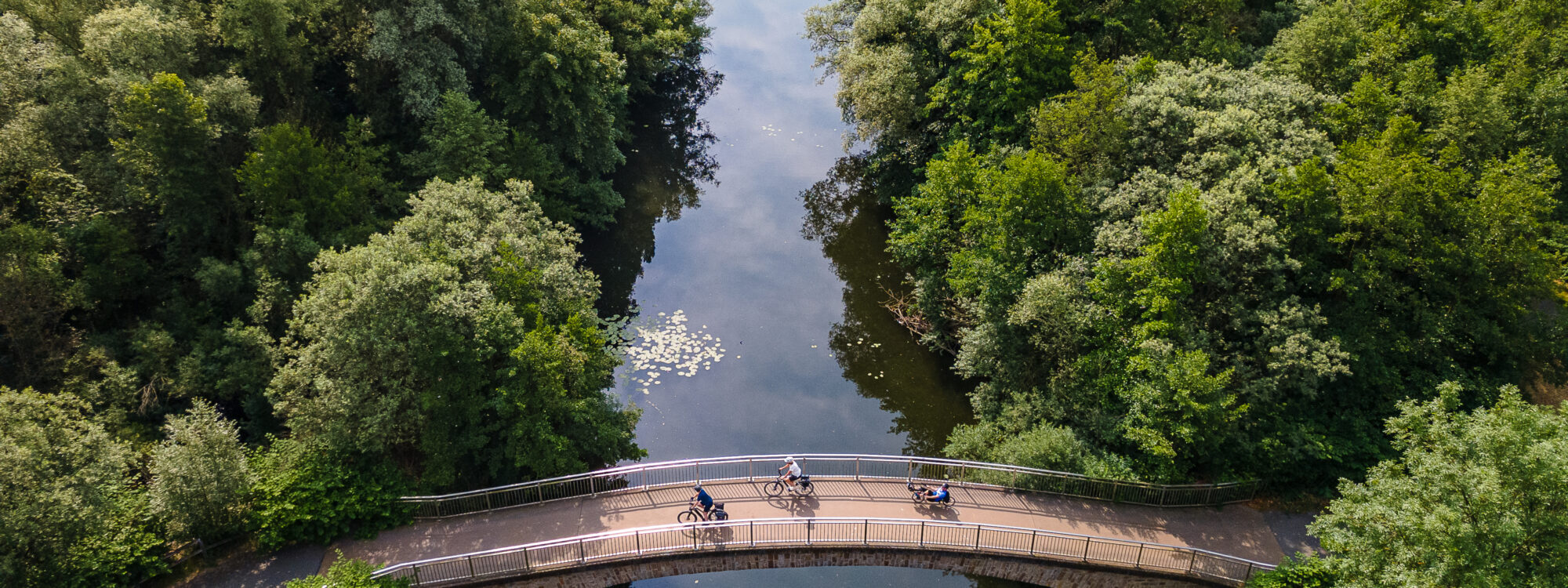
Yes, a bike tour along the North Sea coast can be wonderful, if it weren't for the long journey, which makes a day trip from the Ruhr area almost impossible. But perhaps a nearly comparable bike tour can be experienced closer to home in the Ruhr cycling region? Plenty of water, a ferry ride, and seafood should be on the agenda: quite doable, especially when the big herring festival is on in Duisburg.
You are currently viewing placeholder content from the standard version . To access the actual content, click the button below. Please note that this will involve sharing data with third parties.
My maritime bike tour in the Ruhr area starts at CentrO Oberhausen and leads as a roughly 50-kilometer-long circular route to the Rhine, then to Duisburg and back to Oberhausen.
Let's get started in the radrevier.ruhr region.
My route begins by passing the Oberhausen Gasometer, then continues to the Rhine-Herne Canal and a little further to the Emscher River, before the actual circular route begins. The HOAG route is a former railway line that once connected the industrial plants in Oberhausen with the Rhine port in Duisburg-Walsum. Today, the HOAG route is one of the best-known railway lines in the Ruhr region, offering relaxed cycling away from road traffic in the radrevier.ruhr network.
Family-friendly bike tour with very little road traffic
In general, the tour is family-friendly, at least with older children, provided the length of around 50 kilometers isn't daunting. Only in front of the Sterkrade coal mine and the Rhine ferry, as well as in the center of Duisburg, does the route occasionally run alongside the road; otherwise, it follows cycle paths. We cycle along railway lines, Rhine dikes, and canal banks, completely away from road traffic.
The Sterkrade coal mine in Oberhausen
After the Oberhausen Gasometer, the Sterkrade Colliery is certainly the most significant industrial heritage site on this tour. Coal mining began here at the start of the 20th century and, in conjunction with other collieries, continued until 1991. The cycle path runs directly past the historic colliery tower and is part of the Industrial Heritage Cycle Route.
The HOAG route in the radrevier.ruhr region
We cycle onward towards the north of Duisburg along a gravel surface. A few roads need to be crossed, but otherwise the signage to the Orsoy Rhine ferry is excellent. Of course, you mustn't miss the turnoff just before the end of the HOAG route, otherwise you'll end up in the Walsum harbor. The HOAG route is also part of the tourist junction system in the radrevier.ruhr region, which cyclists can easily use for orientation.
Holiday feeling on the Rhine
The small car ferry shuttles constantly across the Rhine, so the wait is manageable. When we arrive by bike, the ferry is just on the other side, leaving time for a quick chat with the other cyclists. For me, these are always valuable moments to learn tips and tricks from other cyclists and maybe even pick up a new tour suggestion.
With the massive power plant and blast furnaces of thyssenkrupp in the background, the panorama is somewhat unusual, but simply fitting for the Ruhr region. A stark contrast awaits us on the other side of the Rhine.
The small village of Orsoy
A historic rampart promenade encircles the small and charming village of Orsoy. Arriving by ferry, you pass through a historic gate into the village center – the industry you just saw seems light-years away. Orsoy is certainly a good place for a short break, but we're eager to continue on, as we're looking forward to a delicious herring roll at the festival in Duisburg, even though the cyclists in the cafes and beer gardens look very relaxed and happy.
The Rhine Cycle Route in the Ruhr cycling region
Crossing to the other side of the Rhine, the landscape changes noticeably. Everything seems more rural and much more tranquil – more Lower Rhine than Ruhr area. We drive through fields of blooming potatoes and vast stretches of barley, keeping our next destination, the A42 motorway bridge, firmly in sight.
As beautiful as the Rhine crossing in Orsoy was, the crossing over Germany's most famous river here at the A42 is far less pleasant. Even though the bridges are massive structures, impressive in their sheer size, cycling alongside a motorway and the resulting inhalation of rather unhealthy air isn't exactly enjoyable. Of course, one could cycle further upstream, but the next Rhine bridge would make the tour too long for us.
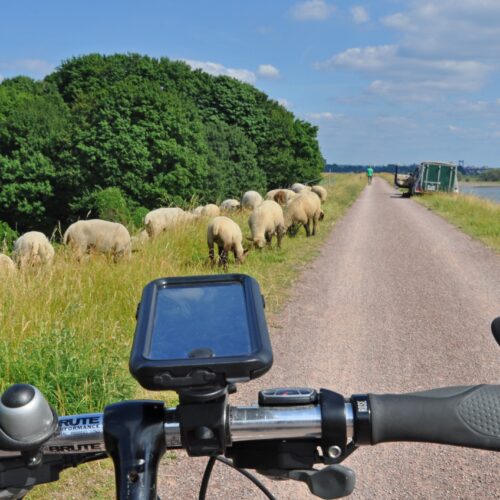
The bike tour becomes all the more enjoyable on the Rhine dike. With a beautiful view of Duisburg, we pass a flock of sheep and are immediately reminded of the lambs grazing on the dikes of the North Sea. The sun is shining brightly, and we're glad we chose the appropriate SPF before setting off. Naturally, our hunger and anticipation for the fish sandwich grow with every pedal stroke as we get closer to the herring festival.
Harbor flair in the world's largest inland port
We arrive in the city of Duisburg and quickly realize that Duisburg is clearly a hub for many cycling routes. And, of course, we learn a great deal from information panels about its history as an important port city in Germany and its significance for the industrialization of the entire Ruhr region.
The route now leads through what is still the world's largest inland port . Large ships, enormous container terminals, and even an old sea rescue cruiser amaze us, even though things are rather quiet in the harbor basin (probably because it's Sunday).
Finally, we reach the Ruhr River and cycle a short distance upstream along the popular Ruhr Valley Cycle Path (Note: The major construction site at the Kaßlerfeld roundabout makes navigation difficult for cyclists (as of January 2023)). We quickly turn off, however, towards the Inner Harbour , Duisburg's trendy district, and even come across a submarine. It's not a real one, but an artwork, a relic from the European Capital of Culture RUHR.2010. It was installed on Lake Baldeney in Essen as part of the "Ruhr Atoll" project and is now moored at the Küppersmühle Museum.
The longing for a fish sandwich
From the inner harbor, we made a detour to the city center, to Königstraße. The big herring festival is held here every year. We've wanted to visit this culinary festival for years, a long-cherished day trip dream. Well, it will remain a dream for another year, as it's already 19 p.m. and the stalls are already being dismantled. It's annoying when you don't think it's necessary to properly check the correct opening hours. Being able to read is definitely an advantage; a really stupid planning error. Oh well: we'll try again next year!
So, we finish the tour without the planned herring sandwich. The route leads back to Oberhausen along the Rhine-Herne Canal. The ground on the right bank is rather wooded in places; the northern bank is more suitable. Therefore, we switch sides at the Oberhausen lock. The gasometer now guides us for the last few meters, and we cycle leisurely right along the water.
This tour has a real maritime flair – even without the herring sandwiches. There are plenty of places to stop for refreshments: whether in Orsoy, in Duisburg's inner harbor, at CentrO Oberhausen, or at one of the many restaurants along the way. Those who want to shorten the tour and avoid Duisburg's city traffic can take a very bike-friendly route north of the inner harbor through the Duisburg-Nord Landscape Park and along the Green Path. I highly recommend this route: an easy tour requiring a moderate level of fitness, but one that truly impresses with its beautiful scenery!